

Blog
Focused, Radial, and Unfocused Shockwave: Why SoftWave Technology Is Different

Not All Shockwave Is the Same: What York, PA Patients Should Know
If you have been researching shockwave therapy for stubborn pain in York, PA, you have probably noticed that the term covers a lot of ground. One clinic advertises "radial shockwave," another mentions "focused shockwave," and a third talks about "broad-focused" or "unfocused" waves. It is easy to assume these are just marketing labels for the same machine. They are not. The type of wave a device produces, and the way that wave travels through your tissue, has a real effect on how much of your target area actually gets treated. Understanding the difference helps you ask better questions and make a more informed choice about your care.
At Harcourt Chiropractic Office, Dr. Gary Harcourt uses SoftWave TRT, a broad-focused electrohydraulic technology from the OrthoGold family of devices. This article explains the three main categories of shockwave in plain language, then walks through why SoftWave's approach to coverage and depth is genuinely different. The goal is not to overstate anything, but to give you an accurate picture of how the technology works and why it may matter for your particular problem.
The Three Main Types of Shockwave
Almost every shockwave device on the market falls into one of three buckets based on how it generates and shapes its acoustic energy. Here is how they compare.
Radial Pressure Waves
Radial devices, sometimes marketed as radial pressure wave or RPW units, are the most common and the most affordable. A projectile inside a handpiece is fired against an applicator that sits on the skin. That impact creates a pressure wave that enters the body and spreads outward from the contact point, a bit like ripples fanning out from where a stone hits water.
Because the energy radiates outward from the surface, radial waves are strongest right at the skin and weaken quickly as they travel deeper. This makes them well suited to problems that sit fairly close to the surface. The trade-off is depth. For tissue that lies well below the skin, a radial wave has often lost much of its strength before it arrives. Technically, many radial devices produce pressure waves rather than true shockwaves.
Focused Shockwave
Focused shockwave devices take the opposite approach. Instead of spreading energy out, they concentrate it. Using electromagnetic, piezoelectric, or focused electrohydraulic sources, these machines drive their acoustic energy toward a single narrow point at a chosen depth inside the body. Think of a magnifying glass gathering sunlight into one small, intense spot.
The advantage is that focused waves can reach deeper structures and deliver a lot of energy to that precise focal point. The limitation is the flip side of the same design. The intense zone is small, so the practitioner has to aim carefully and often relies on the patient's feedback or imaging to keep the focal point on the right spot. If the true source of the problem is spread across a broader region, or if its exact location is hard to pin down, a narrow focal point can miss a good deal of the tissue that needs attention.
Broad-Focused (Unfocused) Electrohydraulic Waves
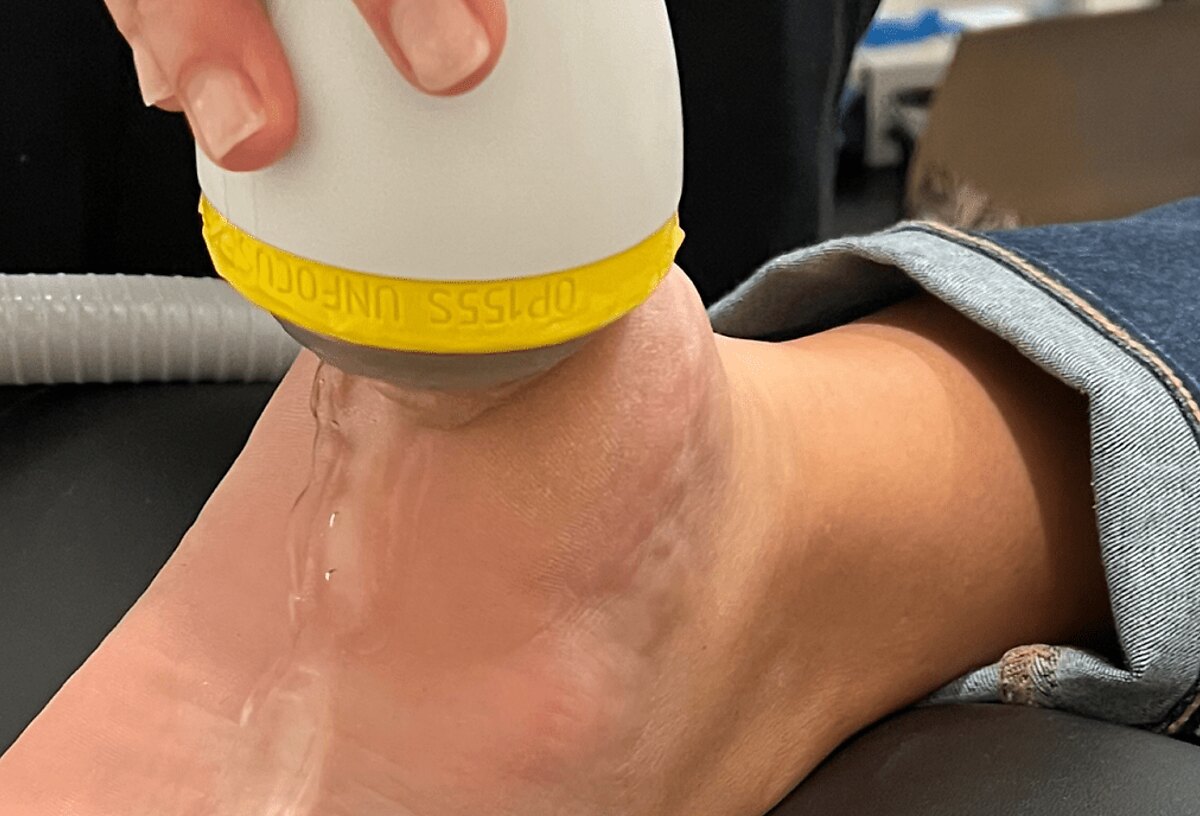
SoftWave TRT sits in a category of its own. It is an electrohydraulic system, which means each wave begins with a tiny, controlled electrical spark inside the applicator. That spark instantly vaporizes surrounding fluid and creates a genuine acoustic shockwave. What happens next is the key difference. The spark sits at the focal point of a patented parabolic reflector, and that reflector redirects the energy outward into a wide, broad pattern instead of collapsing it into a single point.
The result is often described as broad-focused or unfocused. The waves spread wide and travel deep at the same time, covering a large volume of tissue rather than one pinpoint target. SoftWave is the only broad-focused shockwave technology of this kind, which is what separates it from both radial and traditional focused systems.
Why Broad and Deep Coverage Matters
Pain and injury rarely respect neat boundaries. A cranky shoulder, a nagging knee, or chronic low back trouble usually involves a region of tissue, not a single dot you could mark with a pen. That is where the SoftWave design becomes practical rather than just theoretical.
Because the waves fan out broadly, they can reach the whole area of concern in a single pass, and they do it without depending on the practitioner hitting an exact focal point. Because they also carry real energy to depth, they are not limited to shallow tissue the way many radial devices are. In short, broad coverage improves the odds that the actual target gets treated, and depth means that target can sit well below the surface.
Reaching that tissue is the point, because the wave itself does not heal you. What it is designed to do is stimulate your body's own repair systems. When SoftWave energy passes through the target area, it is meant to trigger the body's natural healing cascade.
What the Healing Cascade Involves
In plain language, SoftWave is designed to prompt several biological responses that support recovery. Research on this class of therapy points to mechanisms such as:
- Activation and migration of the body's own resident stem cells toward the treated area.
- Angiogenesis, the formation of new blood vessels, supported by growth factors such as VEGF and eNOS.
- Cell proliferation and support for collagen, part of how tissue rebuilds.
- Modulation of inflammation so the body can move through it more effectively.
- Regulation of immune signaling through pathways such as toll-like receptors.
- Clearance of aged, worn-out (senescent) cells that can slow healing.
The broader and deeper the coverage, the more of the affected tissue can potentially take part in this response. That is the core reason the wave type is worth understanding rather than treating all shockwave as interchangeable.
If you are weighing your options in York and want to know whether broad-focused SoftWave therapy is a sensible fit for your situation, Dr. Harcourt can walk you through it in person. Request your SoftWave consultation with Harcourt Chiropractic Office today and get answers specific to your body, not just the general science.
What to Expect With SoftWave
SoftWave sessions are non-invasive. There are no needles, no drugs, no surgery, and no downtime, so most people return to their day right afterward. A typical session runs about 10 to 15 minutes, and care is usually delivered as a series over roughly 6 to 8 weeks. Because the therapy works by stimulating your own repair processes, healing can continue for weeks to months after your final session. Many patients notice a change early in their care, though everyone responds differently and results are never guaranteed.
It is also worth noting where the technology stands on solid ground. SoftWave devices are FDA-cleared for the activation of connective tissue, a temporary increase in blood flow, temporary relief of minor muscle and joint pain, the treatment of chronic diabetic foot ulcers, and the treatment of acute second-degree burns. This class of technology has been studied at leading institutions and is used by clinicians who work with professional and collegiate athletes. SoftWave therapy is not a replacement for medical advice, and Dr. Harcourt will help you understand whether it makes sense alongside your overall care.
Ready to Take the Next Step?
Choosing the right kind of shockwave matters, and broad-focused SoftWave technology is built to reach your target area with the wide, deep coverage that pinpoint systems can miss. If you are ready to see whether it may help your pain, the Harcourt Chiropractic Office team in York is glad to help.
Request your SoftWave Therapy new patient visit online today
Contact Harcourt Chiropractic Office
Harcourt Chiropractic Office
1630 West Market Street
York, PA 17404
Phone: (717) 843-2542
Our Main Office Website: https://yorkrelief.com/
‹ Back